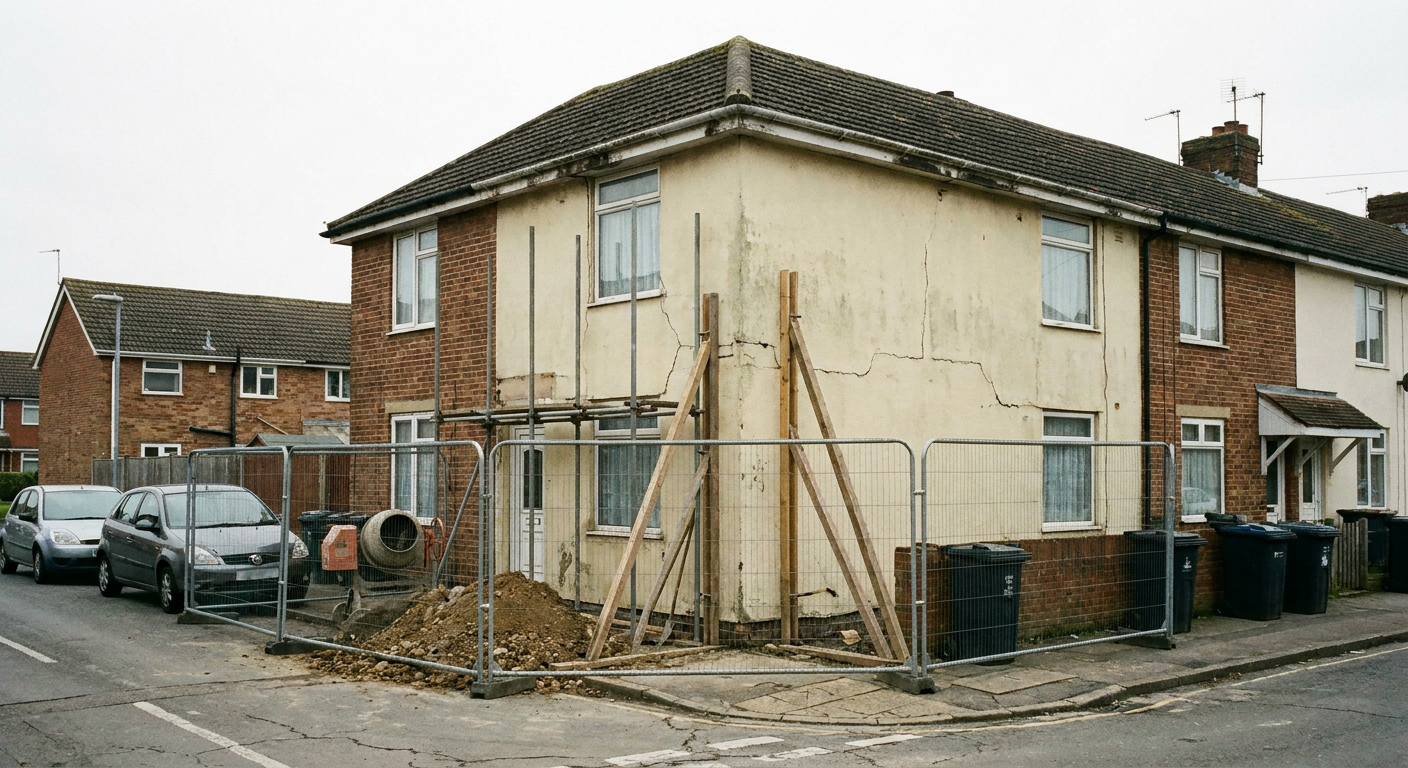
Around Croydon
Areas covered around Croydon
Pick your area below to read about the ground conditions and crack patterns local to your home. Describing what you have noticed costs nothing, and a specialist firm can then tell you if it matters.
North Croydon: Thornton Heath, Norbury and South Norwood
Homes in Thornton Heath sit on London Clay that shrinks when the weather dries out, so cracks often appear near windows and door frames during long summers. A specialist surveyor can measure the movement and determine whether the ground is still shifting or has settled.
Norbury houses show similar signs because the soil profile matches. Cracks here tend to open wider at the top than the bottom, which points to clay shrinkage rather than simple settling. The specialist firms working in these streets know the pattern well.
South Norwood brings drains and mature trees into the picture. Tree roots pull moisture from the subsoil while older drainage pipes leak and wash fine particles away. Both processes leave foundations without support. A CCTV drain survey pinpoints where water escapes underground, so the repair targets the actual cause rather than just filling the crack.
Central areas: Addiscombe, Waddon and Shirley
Addiscombe homes share the clay problem found further north but also deal with large street trees planted close to pavements. Roots spread much wider than the canopy above, reaching under footings and drawing out the moisture that keeps the soil stable. When the clay dries, it contracts and the wall above drops.
Waddon properties often reveal leaking drains as the main trigger. Water escaping from a cracked pipe softens the ground beneath the foundation until it can no longer carry the weight. Fixing the pipe comes before any structural work begins, because stabilising a house on wet ground achieves nothing.
Shirley sits slightly higher and the geology changes, but subsidence still happens. Movement here usually shows up as diagonal cracking across internal plasterwork. A structural assessment determines whether resin injection or traditional underpinning suits the depth and type of soil involved.
South Croydon: Selsdon, Sanderstead and Purley
Selsdon slopes bring their own complications. Houses built on gradients experience uneven pressure, so one side of the foundation settles faster than the other. Tree roots on the downhill side accelerate the tilt by extracting more water where the soil is already thinner.
Sanderstead sits on chalk overlaid with patches of clay. Where the clay meets the chalk, drainage behaves unpredictably. Water pools against the boundary instead of soaking through evenly, creating soft spots that allow part of the footing to sink. Specialist engineers map these boundaries before proposing a fix.
Purley surveys frequently uncover seasonal movement tied to dry spells. Hairline cracks that open in August and close again by November suggest the ground is responding to rainfall rather than failing permanently. Monitoring over twelve months separates temporary shrinkage from progressive damage that needs intervention.
The edges: New Addington, Coulsdon, Kenley and Upper Norwood
New Addington was built rapidly after the war, and some estates used shallow foundations that react quickly to soil changes. Cracks appearing along mortar joints or stepping through brickwork indicate the wall is following the ground downward. Underpinning extends the foundation depth past the active clay layer.
Coulsdon and Kenley share heavy clay and dense tree cover. Large oaks and poplars are common culprits, their roots reaching several metres beyond the trunk. Removing a tree without professional guidance can cause heave, where the rehydrated clay swells and pushes the house upward. An arborist and a structural specialist must plan together.
Upper Norwood stands on high ground where sloping sites meet old Victorian construction. Foundations from that era were often shallow by modern standards. Diagonal cracks running from corners toward the centre of a wall suggest differential settlement. Screw piling offers a way to transfer the load to deeper, stable strata without excavating large trenches.
Tell us where your home is and what you see
Send a short description of the crack or sticking door. The details go to a specialist firm covering your part of Croydon for an initial look. There is no fee for this and no obligation to accept any work proposed.
- No charge to ask
- Local specialists only
- No obligation to proceed
Areas Covered
- Thornton Heath
Worried about subsidence in Thornton Heath? Find out what wall cracks, sticking doors and clay soil movement can mean for homes in the area.
- South Norwood
Subsidence in South Norwood can show as stepped cracks, uneven floors or leaking drains. See what to check at home and how a survey is arranged.
- New Addington
Subsidence in New Addington can show in wall cracks, sloping floors and gaps at extensions. Learn the likely causes and the repair options for local homes.
- Purley
A subsidence survey in Purley checks crack patterns, nearby trees, drains and clay ground under the house. See what the checks involve and who they suit.
- Coulsdon
Worried about subsidence in Coulsdon? Learn how clay soil, tree roots and leaking drains cause cracks, and which repair options may follow a survey.
- Addiscombe
Cracks around windows, sticking doors and sloping floors in Addiscombe can point to subsidence. Learn the local causes and the checks that follow.
- Norbury
Subsidence in Norbury shows up as stepped cracks, sticking doors and sloping floors. Read how to tell serious movement from older settlement.
- Selsdon
Subsidence in Selsdon can show as stepped cracks, sticking doors and sloping floors. See what causes movement here and which checks come next.
- Shirley
Worried about subsidence in Shirley, Croydon? Learn which wall cracks matter, how clay soil and tree roots cause movement, and the repair options.
- Waddon
Subsidence in Waddon can start with a leaking drain or shrinking clay. Read the signs in brickwork, the usual causes and what a survey covers.
- Upper Norwood
Subsidence in Upper Norwood often shows in cracks near windows, bays and extensions. Understand the likely causes and the checks that confirm movement.
- Sanderstead
Cracks, sticking doors and uneven floors in Sanderstead homes can point to subsidence. Read the likely local causes and the checks that usually follow.
- Kenley
Subsidence in Kenley shows up as stair-step cracks, gaps around frames and uneven floors. Find out what causes movement here and what to check first.